

It is no longer a matter of partisan speculation; it is an undeniable mathematical reality: the Democratic National Committee is experiencing a financial crisis unlike anything a major American political party has faced in modern history.
As of mid-2026, federal campaign disclosures reveal a staggering asymmetry. While the Republican National Committee sits on a war chest exceeding $120 million with zero debt, the DNC is drowning in $18 million of debt with barely $16 million in cash on hand. The situation has degraded to the point that DNC leadership was forced to put up the party’s physical Washington, D.C. headquarters building as collateral just to secure a $15 million bank line of credit, all while quietly begging vendors to defer billing until after the upcoming midterms.
The mainstream commentary machine has its excuse ready: “It’s just a post-election hangover.” We are told the party is simply reeling from the costly fallout of 2024.
Except we are nearly two full years removed from the 2024 election cycle. Cyclical hangovers subside; structural insolvency requires a systemic liquidity shock.
To understand where the money went, we must look at what else has happened across the federal landscape over the exact same timeframe—events that, on the surface, appear entirely disconnected from party politics.
The Parallel Cut-off
Over the last 18 months, three distinct non-political shocks hit the federal ecosystem:
The DOGE Audit Freeze: Sweeping federal efficiency audits systematically froze or terminated tens of billions of dollars in un-audited federal grants earmarked for non-governmental organizations (NGOs), foreign aid conduits, and domestic “social equity” initiatives.
Contractor Cancellations: Federal agencies aggressively rescinded administrative grants and consulting contracts designed to promote climate policy, DEI directives, and progressive ideological programming.
The Anti-Fraud Crackdown: The Department of Justice and federal law enforcement initiated historic, large-scale prosecutions targeting multi-million-dollar grant and pandemic-relief fraud, shuttering hundreds of bad-actor entities that had operated with virtual impunity for years.
The legacy media treats these developments as isolated administrative stories. But ask yourself a simple question: What happens when you map the financial records of those defunded NGOs, canceled contractors, and indicted fraudsters directly onto Federal Election Commission contribution logs?
Connecting the Dots
The data reveals a pattern that is statistically impossible to ignore.
For over a decade, academic and campaign finance studies have demonstrated an overwhelming demographic imbalance: employees of government-funded non-profits, academic institutions receiving federal grants, and state-subsidized contractors donate to progressive causes and Democratic candidates at rates exceeding 80% to 90%. In many major urban NGOs, executive-level employees regularly donate the legally allowable federal maximum.
Simultaneously, law enforcement audits of systemic grant fraud—from regional food-aid schemes to municipal housing fund diversions—uncovered a recurring secondary signature: individual bad actors orchestrating these fraudulent operations frequently funneled a percentage of their illicit proceeds right back into political action committees, progressive campaigns, and digital fundraising networks like ActBlue.
This brings us to ActBlue itself, which has faced mounting federal and state scrutiny over its donor-verification practices. The platform’s long-standing refusal to require standard CVV security codes or identity verification for small-dollar, prepaid card transactions created a massive, un-audited pipeline—a blind spot capable of masking the true origin of millions of high-frequency “micro-donations.”
When you align these vectors, the mechanism becomes undeniable.
The Gamified Slush Fund
This system did not require a dark room filled with conspirators signing illegal quid pro quo agreements. It functioned far more elegantly through aligned incentives and socialized compliance.
The feedback loop operated in plain sight:
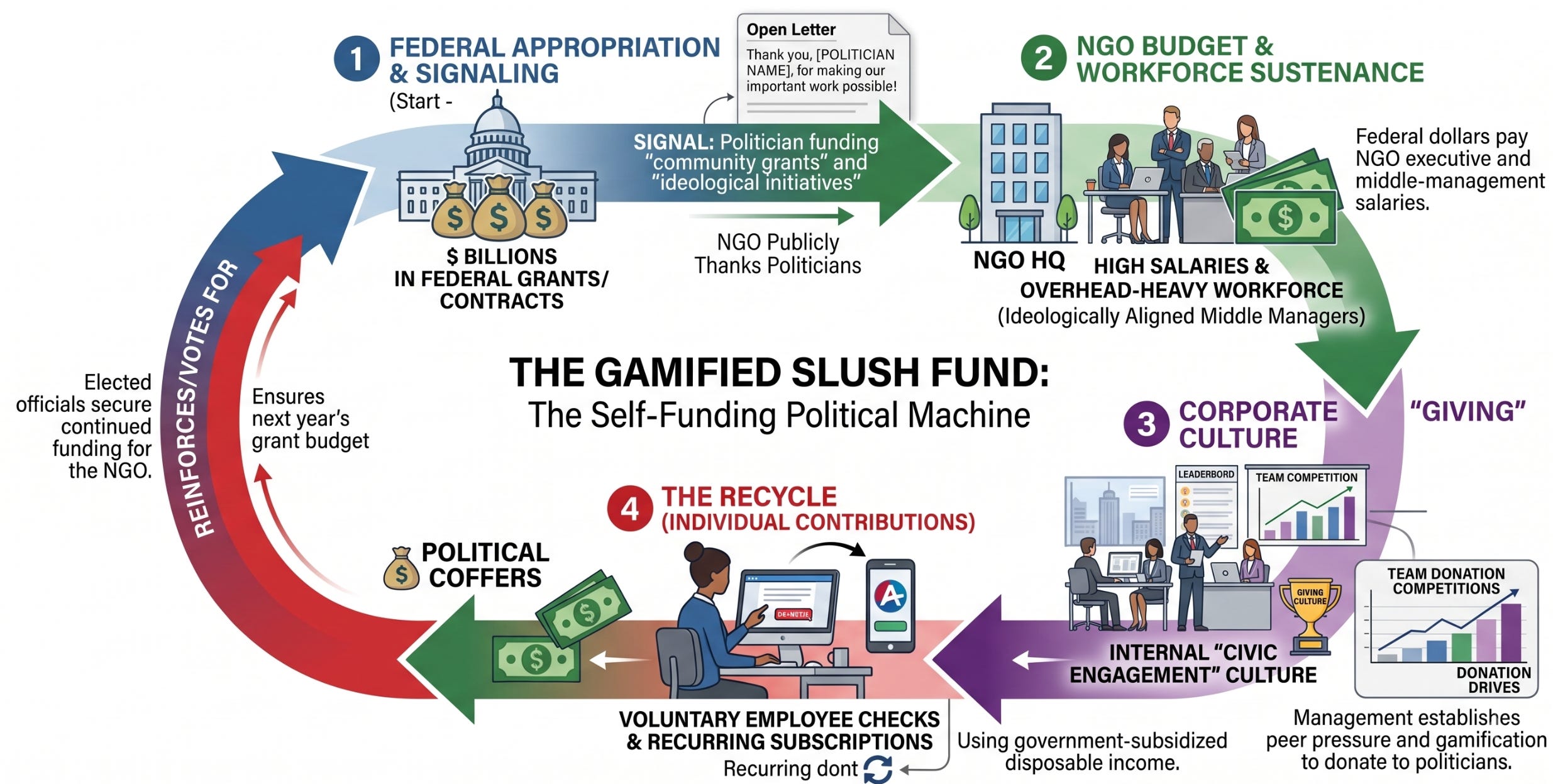
The Signal: Politicians appropriate billions in public money for “community grants” and “ideological initiatives.” The receiving NGO leadership issues public letters thanking those specific politicians for making their “vital work possible.”
The Culture: The NGO uses those federal dollars to build an overhead-heavy workforce of well-salaried, ideologically aligned middle managers. Management then establishes an internal culture of “civic engagement,” setting up team competitions and digital donation drives to support the very politicians who secure their grants.
The Recycle: Employees voluntarily write individual checks or set up recurring monthly ActBlue subscriptions using their government-subsidized disposable income.
The Verdict
For years, the political establishment bragged about its overwhelming dominance in “small-dollar grassroots fundraising.” We were told that millions of ordinary Americans were eagerly chipping in $15 at a time to power the movement.
Now we know the truth. The small-dollar pipeline didn’t collapse because voters lost interest; it collapsed because the middle-management layer of the NGO state no longer has excess, government-subsidized capital to recycle. When federal grant faucets were turned off and un-audited fraud schemes were dismantled, the party’s primary financial engine seized up instantly.
The conclusion is direct, unambiguous, and mathematically inescapable:
The Democratic Party’s relationship with the non-profit state was never about charity, and it was never about altruistic policy implementation. It was a closed-loop economic engine. They didn’t merely fund progressive actions performed by others—they used taxpayer dollars to fund themselves.