

In the world of software architecture, when a system produces wild, contradictory outputs from identical input parameters, we don’t assume the machine is thinking; we look for the hidden logic gate causing the discrepancy. If the engine consistently applies one set of validation rules to Column A and an inverted set of rules to Column B, we are looking at an intentional, coded bias within the runtime environment.
Today, a massive structural contradiction runs through the core of Hollywood’s premier world-building engine.
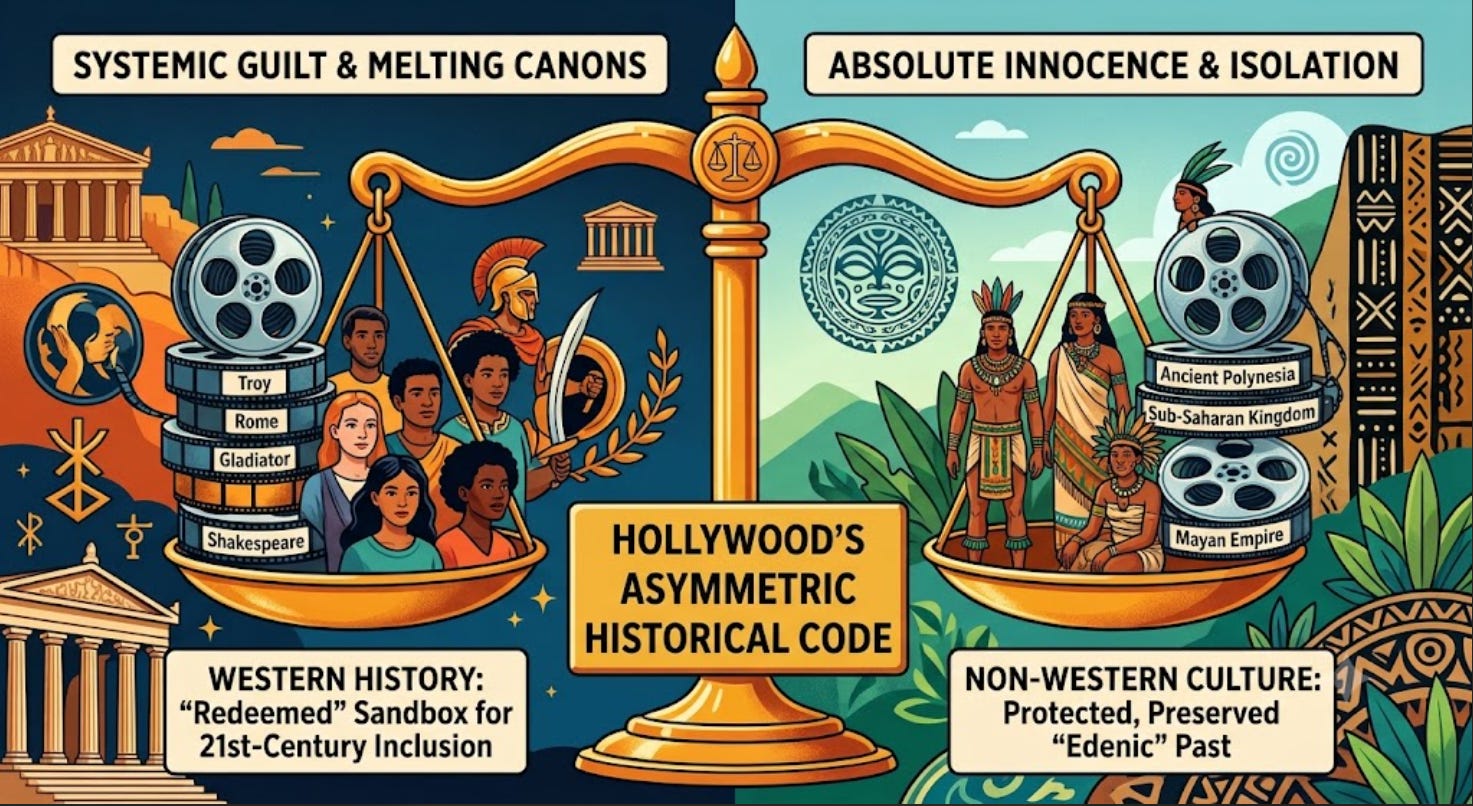
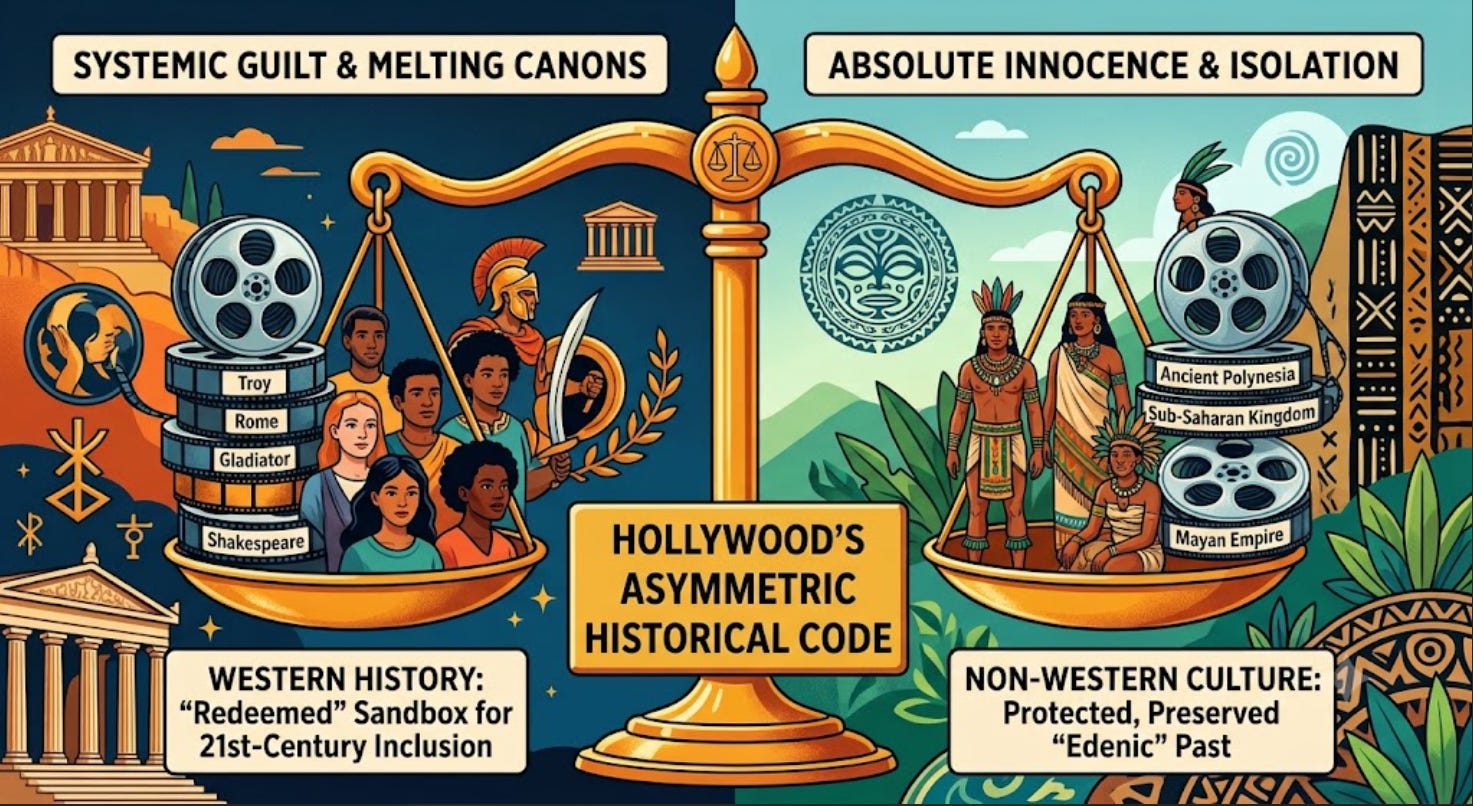
When the entertainment industry handles historical settings or foundational mythologies originating from non-Western or indigenous cultures, it operates on a principle of absolute preservation. In projects like Black Panther or the live-action Moana, the casting and environmental rules enforce a strict, un-breached firewall around the setting’s demographic and geographical telemetry. To inject modern, bicoastal Western diversity into ancient Polynesia or an isolated sub-Saharan kingdom would be instantly flagged by critics and creators alike as an act of cultural colonization. The world must remain ethnically and demographically insulated to protect its internal authenticity.
Yet, when the exact same industry compiles a Western epic or European mythology—such as the recent cinematic adaptation of Homer’s The Odyssey—the architectural rules are completely inverted. Suddenly, the historical and geographical realities of the Bronze Age Mediterranean are dissolved. The setting is treated as a borderless, neutral sandbox where the cast must mirror the multi-ethnic makeup of a 21st-century global metropolis.
To understand why Hollywood aggressively enforces an insular boundary for one hemisphere while gleefully melting it away in the other, we have to look past the surface-level corporate messaging of “inclusion.” If we audit the system code running underneath the screen, we find that the modern creative class is no longer evaluating historical texts through an anthropological lens. Instead, they are running a highly specific, secularized theological program: The Allocation of Absolute Innocence versus Systemic Guilt.
The Secularized Garden: Coding the Blameless Past
The narrative software governing modern media does not see history as a continuous, messy spectrum of universal human behavior. Instead, it relies on a secularized adaptation of the Genesis archetype—specifically, the structural dynamic of the Garden of Eden and the Serpent.
In this ideological database, pre-modern, non-Western, and indigenous societies are cast as the uncorrupted Garden. They are romanticized as pristine, ecologically balanced, and existentially innocent eco-paradises that lived in near-perfect internal harmony. Within this framework, Western civilization functions as the structural equivalent of the Serpent—the singular, corrupting force that introduced expansionism, territorial exploitation, and systemic institutional malice into a blameless world.
To maintain the absolute sanctity of this Edenic myth on screen, the system requires visual and demographic isolation. The cast of these worlds must be kept pure on a screen-delivery level because displaying internal ethnic fragmentation, systemic pre-colonial warfare, or native class exploitation would break the core software patch. If the audience is forced to recogni
ze that human nature, territorial conquest, and tribal dominance are universal human traits rather than Western inventions, the entire ideological narrative crashes. The Garden must be preserved in amber to keep the fable of an uncorrupted origin state intact.
The Melted Canvas: Western History as the Fallen State
Because the institutional narrative assigns a default state of global, historical guilt to Western civilization, European history and classical mythology are treated not as distinct cultural inheritances, but as the aftermath of the Fall.
Consequently, Western epics are denied their own localized, isolated “Garden” status. When modern directors adapt a text like The Odyssey, the industry praises globalized casting sandboxes because the Western canon is viewed as a public domain asset that must be forcibly “redeemed” or reconstructed via modern administrative compliance frameworks.
By melting away the specific, localized demographic realities of Bronze Age Ithaca and replacing it with a hyper-diverse modern ensemble, the filmmakers are attempting to perform a retroactive ethical correction on the historical timeline. The irony of this architecture is glaring: under the guise of championing “inclusion,” the system actively erases the actual, distinct cultural geography and ethnic lineage of the ancient Mediterranean. It treats European heritage as a borderless canvas while granting sovereign preservation to everyone else.
The Fatal Glitch: The Infantilization of Human History
The ultimate tragedy of this asymmetric framework is that it doesn’t actually elevate non-Western cultures—it profoundly infantilizes them.
By treating pre-colonial civilizations as static, passive, and uniformly peaceful eco-paradises, Hollywood strips those societies of their actual, complex human agency. Historically, pre-Columbian empires, Eurasian nomadic tribes, and sub-Saharan kingdoms were dynamic, aggressive, and highly sophisticated political actors. They built massive trade networks, engaged in brutal territorial expansion, managed complex systems of slavery, and navigated intricate, bloody struggles for tribal and imperial dominance for millennia before European contact. They were not passive children tending a pristine garden; they were fully realized humans playing the brutal, high-stakes game of history.
By flattening their real, raw history to fit a 21st-century ideological fable, Hollywood reduces vibrant, complicated, and formidable civilizations into one-dimensional moral props designed to soothe a modern Western guilt complex.
The Illiteracy of the “Modern Upgrade”
This system-wide replacement of primary-source reality with ideological commentary inevitably breeds a profound cultural illiteracy among the creators themselves.
We see this glitch clearly when actresses portraying figures like Helen of Troy celebrate how a modern adaptation is a “victory for diversity” because it grants unprecedented “screen time” to women—frequently joking that an author like Homer would be “horrified” by the progressive upgrade.
Such statements reveal a complete failure to parse the literal source code of the text. Anyone who has sat down to read The Odyssey knows it is entirely driven, managed, and controlled by high-agency, formidable female powerhouses. Athena operates as the ultimate systems architect of the entire epic, manipulating the gods and directing the physical retrieval of Odysseus. Penelope runs a masterful, 20-year psychological defense campaign against an entire occupying army of predatory suitors using unmatched wit and structural deception. Circe and Calypso possess absolute existential sovereignty over their domains, holding the protagonist’s fate entirely in their hands.
The ancient text didn’t need a modern HR department to inject female agency; the agency was hard-coded into the original architecture. The modern creative class isn’t updating these epics to make them “better”—they are fighting a historical strawman because they rely on secondary pop-culture summaries rather than primary-source data.
The Verdict
When a system consistently values compliance with an external administrative award charter over the internal logic of its own world-building, the resulting output will always feel jarring to the end-user.
True consistency would mean recognizing that every human culture—regardless of its geographic hemisphere—deserves the same dignity of historical fidelity, demographic authenticity, and universal human complexity. By trapping one half of the world in a patronizing myth of pristine innocence and forcing the other half into an endless cycle of demographic deconstruction, Hollywood has abandoned the pursuit of art. It has converted the cinematic screen into a clinical compliance dashboard—and that is exactly why the machine is breaking.