

Complete control over private industry has always been—and remains—the primary end-goal of the progressive administrative state.
Their preferred playbook is incrementalism: a steady, deliberate march toward total market capture, with every single step packaged as a “common-sense regulation for the public good.” Price controls, mandatory manufacturing codes, and forced benefit packages are all deployed under the guise of expanding “accessibility” or “worker protection.” In reality, the economic physics are unyielding: the cost of every mandate is immediately passed down to consumers via higher prices and to workers via depressed wages.
The Democratic Socialists of America lay this paradigm bare. While they advocate for the direct government seizure of industry, they couch their language to extract compliance from an unwitting electorate. They frame state seizure as the workers “taking the means of production”—promising that by simply deleting the “profit motive,” prices will plummet and wages will magically surge.
It shouldn’t take a rocket scientist or an economist to notice that the math doesn’t math.
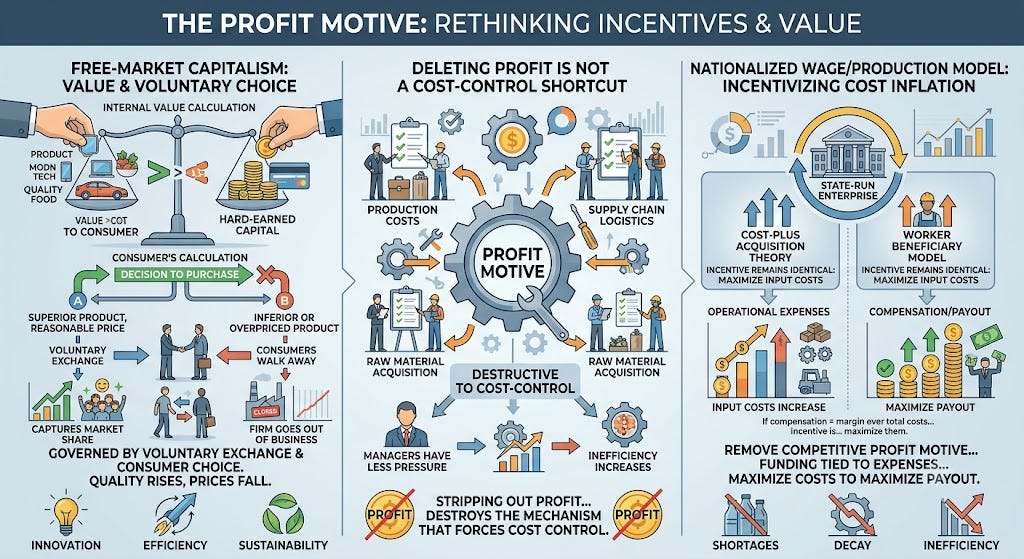
Yet, inconceivably, the general public falls for it. The level of economic illiteracy required to accept this script defies reason. Most people fail to realize that stripping out profit doesn’t make lower prices or higher wages possible—it destroys the very mechanism that forces managers to control costs across production, supply chain logistics, and raw material acquisition.
Look at one of the state’s most infamous economic tools: Cost-Plus contracting.
If an entity’s compensation is calculated as a margin over total costs, the economic incentive is not to minimize costs, but to maximize them. If you remove the competitive profit motive and make the “workers” the sole beneficiaries of an enterprise—with baseline funding tied directly to operational expenses—the incentive remains identical: maximize input costs to maximize payout.
Free-market capitalism drives quality up and prices down because it is governed by voluntary exchange and consumer choice. Consumers trade their hard-earned capital for a product only when their internal value calculation determines the product is worth more to them than the cash in their pocket. If a firm produces an inferior or overpriced product, consumers walk away, and the firm goes out of business.
Without the desire to capture market share, what incentive exists for a state-run entity to innovate, improve quality, or maintain variety?
Simply put: None. Every single time socialism is attempted, product diversity rapidly collapses. “Luxuries” disappear from production entirely, while basic “necessities” devolve into severe shortages and rationing.
This is the mathematical output every single time. Yet, the public remains mesmerized by political theater and promises of “something for nothing”—operating under the naive assumption that the hyper-productive will continue producing out of pure benevolence.
The historical record is clear: the only commodity socialism has ever produced in abundance is scarcity, misery, and economic decay.