

As a traveling insurance salesman makes his way up the dirt driveway, his eyes scan an impeccably manicured farm. Of all the properties on his route, this one always stood out. But as he approached the front porch, he stopped dead in his tracks. There, inside a meticulously maintained, full-featured pen, sat a magnificently proportioned hog. The animal was robust, healthy, and clearly cared for with an extraordinary degree of attentiveness.
The salesman mentally noted the flawless operation, concluded his standard business with the farmer, and agreed to return every six months to review the property’s coverage parameters.
Six months later, the salesman returned. As he walked past the pen, he did a double-take. The hog was still massive and clean, but it was missing its front left leg. In its place, a crude peg prosthesis was carefully strapped to its shoulder.
Six months after that, the salesman returned again. The hog was now missing a back leg.
Six months later, the other back leg was gone.
By the next visit, the remaining front leg had been harvested, replaced by a clumsy wheeled cart. Finally, on his last visit, the salesman walked up to the house, looked over at the pen, and found it completely empty. The hog was entirely gone.
Though the salesman had always maintained an absolute baseline of professional detachment, his curiosity finally overrode his restraint. As he sat across from the farmer at the kitchen table, he leaned forward. “I hate to ask, sir, but what exactly happened to that magnificent hog?”
A genuine, wide smile instantly broke across the farmer’s face. His eyes lit up with profound pride. “That hog? Son, that was the single greatest, most prize-winning hog I have ever had in my entire life. That animal wasn’t just livestock—he was an absolute hero.”
“A hero?” the salesman asked, bewildered.
“Oh, you bet,” the farmer exclaimed. “The winter before last, my youngest daughter was ice skating on the pond at the edge of the property. The ice cracked, and she fell right through into the freezing water. That hog heard her screams. He didn’t just sit there—he broke straight through the heavy wooden gate of his pen, bolted into the barn, grabbed a coiled rope in his jaws, ran all the way down to the pond, threw one end to my daughter, and physically hauled her out, saving her life!”
The salesman gasped. “My God! And that’s how he got hurt? That’s how he lost his limbs?”
“No, no! Not at all!” the farmer replied, waving his hand dismissively. “He was completely fine! Healthy as a horse!”
The farmer shifted in his chair, eager to keep going, and continued to recount additional, increasingly spectacular heroic acts of the pig:
The Electrical Fire Save: The following spring, an outlet in the kitchen short-circuited in the dead of night, sending thick smoke rolling through the house. The hog smelled the smoke, began slamming his body against the farmhouse door until it splintered open, dragged the sleeping family out of their beds by their blankets, and managed to alert the local volunteer fire department before the structure was lost.
The Home Invasion Defense: A few months later, a heavily armed, coordinated team of home invaders breached the back perimeter of the property. The hog intercepted them in the dark, single-handedly neutralized the threat, disarmed the lead operative, and pinned them down until the county sheriff arrived to process the scene.
The Lost Child Tracking Event: Just last autumn, a neighbor’s toddler wandered off into the deep, unmapped wilderness surrounding the valley. While search and rescue teams were completely paralyzed by the terrain, the hog processed a scent trail, navigated a blinding blizzard, located the child sheltering in a hollow log, and carried them miles back to safety on his back.
With the conclusion of each spectacular exploit, the salesman’s posture grew increasingly tense. His breathing turned shallow, his eyes widening in a mix of awe and sheer neurological friction.
“And he wasn’t injured during the fire?” the salesman pressed, his voice rising, tinged with an urgent, pleading desperation.
“Nope, perfectly fine!” the farmer beamed.
“The home invaders? Surely he took a wound fighting armed men?!” the salesman asked, his voice now frantic, cracking under the strain of an irreconcilable logical paradox.
“Genuinely didn’t have a scratch on him,” the farmer chuckled.
“The blizzard?! Frostbite?! Something?!“ the salesman yelled, completely frustrated, his hands slamming down onto the table.
Finally, entirely exasperated, pushed past the brink of sanity by the absolute structural contradiction of the timeline, the salesman stood up and screamed: “THEN WHY FOR THE LOVE OF GOD WAS HE FITTED WITH PROSTHETICS, AND WHY IS THE PEN COMPLETELY EMPTY NOW?!”
The farmer stopped smiling. He looked at the salesman with a flash of profound confusion, utterly bewildered that an educated man would ask such an incredibly naive question. He shrugged his shoulders, completely incredulous, and delivered the baseline logic of the farm:
“Well, think about it, son. A pig that good? You can’t just eat him all at once!”
The System Architecture
The standard internet commentary loop is thoroughly addicted to the “boiling frog” analogy when diagnosing the slow erosion of liberty. But the boiling frog is a flawed analogy. It implies a completely passive host that is simply too oblivious to register changes in its ambient environment until a terminal system crash occurs.
The Prized Hog Paradigm introduces the actual, malicious code running inside the modern administrative state: the active exploitation of civic pride, the weaponization of manufactured crises, and a throttled extraction schedule engineered to bypass the host’s natural immune response.
To understand how our current political economy operates, we must map the functional components of this fable onto the live data layers of the corporate-bureaucratic machine:
The Farmer: The Political Extraction Class
The Farmer represents the political managers and state planners. Crucially, he is not written as a cackling, mustache-twirling tyrant who hates the animal; he speaks of the hog with profound, un-ironic reverence. He brags about its utility, builds it a premium enclosure, and validates its status to anyone who visits.
This matches the exact semantic choreography used by spending-addicted politicians. They do not stand at the podium and announce a campaign to bleed the middle class dry. Instead, they code-name their extraction pipelines with terms of worship: “the backbone of America,” “our heroic essential workers,” and “the engines of innovation.” This rhetorical packaging is a mandatory system optimization protocol. It keeps the asset cooperative, productive, and compliant inside the tax-harvesting perimeter while the actual physical consumption occurs behind closed doors.
The Hog & Its Meat: The Productive Class & Their Sovereignty
The Hog represents the productive, self-sustaining sector of the citizenry—the builders, the independent developers, the small business owners, and the technical creators who maintain the physical infrastructure of the nation. Its meat represents their liquid capital, the realized fruits of their labor, and their constitutional autonomies.
A hyper-productive citizen generates a vast surplus of net-positive value. To an administrative state with an infinite spending deficit, that surplus is an un-harvested crop. But the state planners understand basic economic physics: if you implement a 100% asset confiscation script on day one, the host organism suffers a catastrophic shock, production drops to absolute zero, and the system experiences a terminal crash.
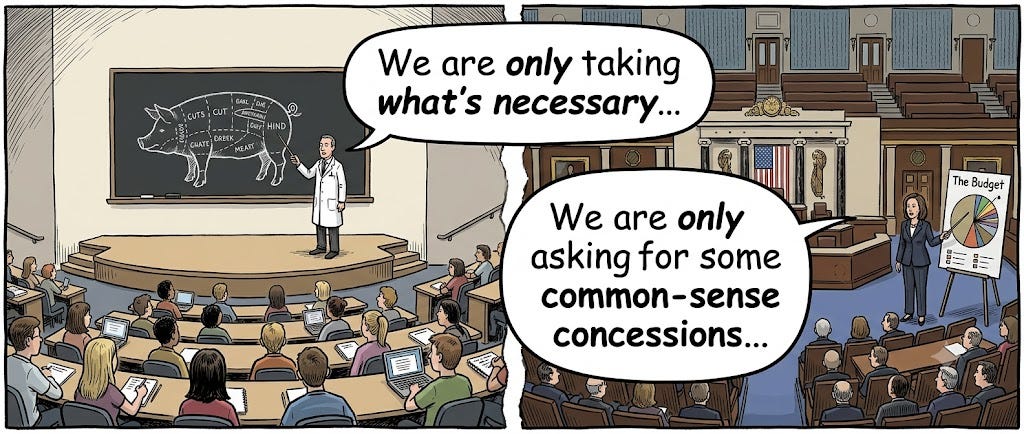
Therefore, the state deploys The “Only” Trap. The consumption must be throttled. The extraction technicians walk into the pen with a bone saw and announce that they “only” need to harvest a highly localized sliver of tissue for an emergency:
It’s “only” a temporary 1% tax on the ultra-wealthy.
It’s “only” a restricted ban on a highly specific category of mechanical components.
It’s “only” a minor, 15-day regulatory pause to buffer a public utility.
The hog is fitted with a prosthetic—a regulatory workaround, an automated inflation adjustment, or a temporary compliance patch—so that the baseline system can continue running. The state carefully spaces out the extraction intervals to give the host time to heal, adapt, and begin producing fresh economic tissue to be carved away during the next fiscal quarter.
The Hog’s Exploits: The Diversion
The spectacular, life-saving feats of the hog represent the profound capacity of the productive populace to absorb macro-system shocks and rescue society during existential crises.
When a structural emergency manifests—whether it is a supply-chain disruption, an economic depression, or a geopolitical threat—the builders and producers immediately execute their emergency recovery routines. They work double shifts, re-engineer logistics on the fly, and sacrifice their personal margins to stabilize the country.
The profound irony of the paradigm is that the state leverages the public’s intense gratitude for these “heroic saves” as an ideological cloaking device . The population is so busy applauding the resilience of the economy, or celebrating the latest state-managed rescue package, that they fail to register the mechanical operations occurring at floor level. The emotional high of surviving the crisis blinds the host to the fact that their baseline operational autonomy just lost another limb.
The Farmer’s Family: The Dependent Subsidized Cohort
The family members who are continuously rescued, nourished, and sustained by the hog’s flesh represent the rapidly expanding, state-subsidized consumer class.
The administrative state does not consume the extracted resources in a vacuum; it uses the harvested wealth to fund redistribution networks, permanent safety nets, and artificial demand subsidies designed to buy structural compliance. Over time, this subsidized cohort is systematically re-engineered to view the extraction process not as predation, but as basic moral benevolence. They love the hog, but their relationship to it is strictly parasitic. They require the continuous, systematic slicing of the productive asset to maintain their own artificial baseline of subsidized comfort.
The Salesman: The Forensic Auditor of Critical Thought
The Traveling Salesman is the singular entity in the narrative operating outside the emotional feedback loops of the farm. He is the only character tracking the multi-year telemetry of the property. He represents Critical Thought—the zero-trust forensic auditor who completely ignores the Farmer’s sentimental public relations speeches and looks strictly at the raw, undeniable degradation of the physical assets.
While the rest of the farm is trapped in a permanent echo chamber of civic validation, celebrating the hog’s “heroism,” the Salesman is running the actuarial math. He is the one asking the simple, devastating diagnostic question: “Why is the foundation of our stability systematically disappearing?”
The Terminal Juncture: Bone and Iron
The ultimate tragedy of the Prized Hog Paradigm is that the asset’s own excellence accelerates its destruction . Because the productive citizenry is so profoundly efficient at innovating, overcoming regulatory obstacles, and generating wealth under pressure, the political planners consistently arrive at the same catastrophic conclusion: the host can handle one more slice. They convince themselves that the engine is infinite. They assume that no matter how many compliance costs they impose, no matter how much capital they extract via inflation, and no matter how many constitutional perimeters they breach, the Bobs of the world will simply adjust their prosthetics and keep pulling the cart.
But human incentives are bound by the hard laws of mathematics and psychology. There is a hard runtime limit to this exploit.
Eventually, the state planners will walk into the pen with their tools, only to realize they have reached the core of the skeletal structure. When the tax rates scale too high, when property rights are reduced to a conditional state-managed privilege, and when individual labor is entirely cannibalized to fund an idle, non-producing vanguard, the makers run an exit routine. They relocate their capital, they withdraw their creative labor, or they completely disconnect from the environment.
The problem with the modern political class is that they lack the systems-level foresight to see the empty driveways ahead. They will continue to deliver their sweeping, grateful monologues on national television right up until the morning the final transaction fails. And once the structural foundation of a free society has been systematically carved away and consumed to fund the machinery of state power, the country will face a brutal reality that no legislative update can fix: some things just don’t grow back.