

The Reality Gap
If you are a conservative voter living in California, or a progressive voter living in Texas, your vote for the President of the United States does not actually exist. It is systematically intercepted and incinerated by a state-wide, winner-take-all machine before its mathematical weight can ever be felt in Washington.
The institutional media cartel wants you to believe that resolving this systemic disenfranchisement requires a Constitutional Amendment—a functional impossibility in today’s deadlocked political environment.
This is a deliberate deception. The entire federal election apparatus can be completely re-engineered tomorrow using standard, sub-constitutional statutory law. The machine simply relies on the public remaining completely blind to the bad code written into the system nearly a century ago: The Permanent Apportionment Act of 1929.
The Mechanical Bottleneck
To understand how the trick is executed, we have to look past the political public relations departments and look at basic asset dilution.
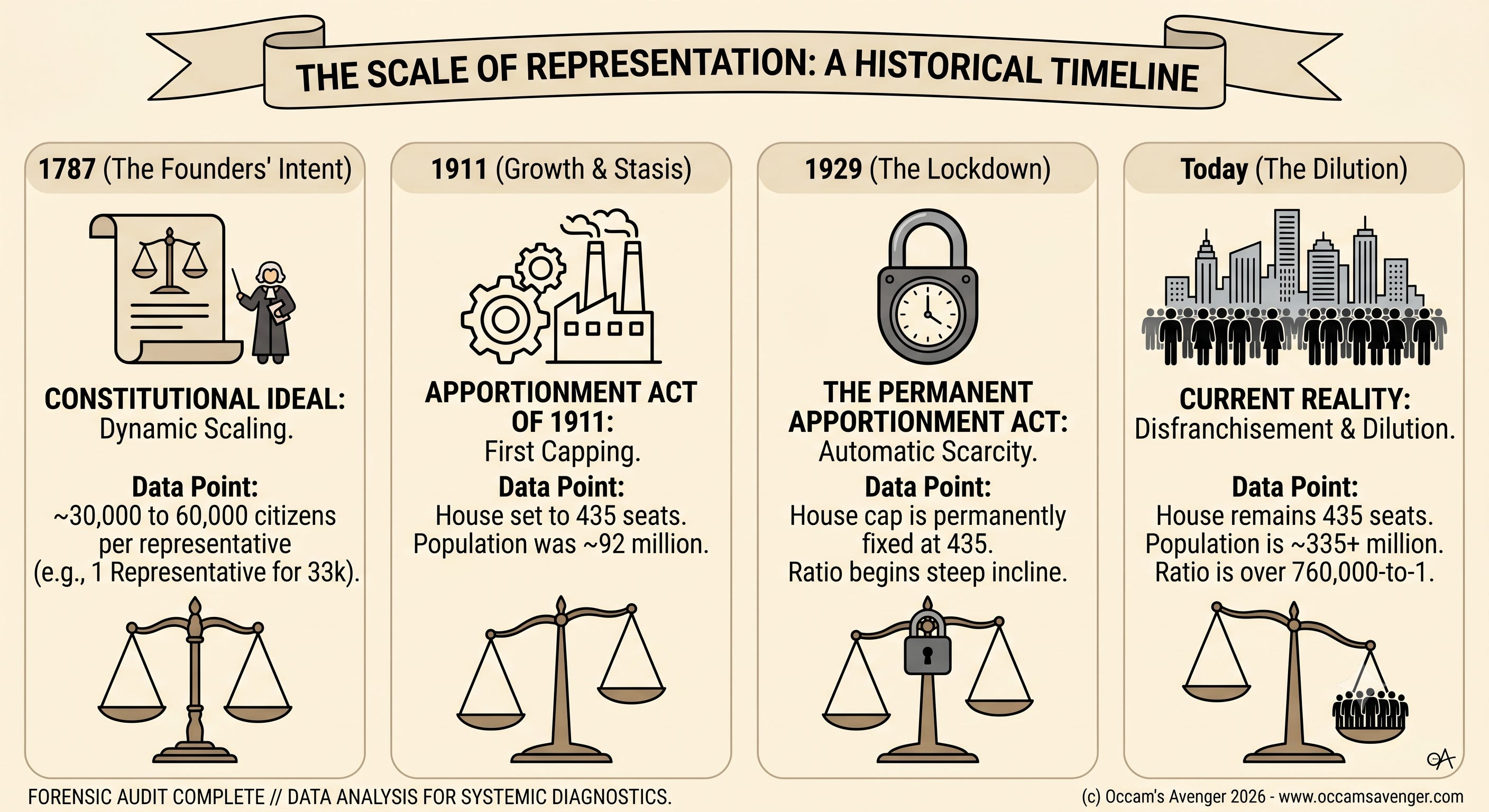
When the Framers engineered the Constitution, they built the House of Representatives to act as a dynamic, scaling mirror of the population. A single representative was meant to speak for roughly 30,000 to 60,000 citizens. It was a tight, hyper-local ratio designed to keep representation granular.
In 1929, Congress quietly capped the House at 435 members—a number derived not from constitutional wisdom, but from a decade of ugly, self-serving legislative paralysis. The 1920 census had revealed a massive population shift from rural communities to industrial cities. Rather than allow power to shift naturally to these growing populations, status-quo politicians spent a decade blocking reapportionment to protect their own jobs.
When they finally forced through the 1929 Act, they hid behind petty bureaucratic excuses—complaining about the administrative costs of larger staffs and literally arguing that the physical House chamber couldn’t hold any more desks. They locked the stadium doors but kept letting millions of new residents into the arena.
Today, the average congressional district is choked with over 760,000 people—this artificial scarcity is the exact oxygen that makes gerrymandering fatal.
When a district spans multiple counties and three-quarters of a million people, it behaves like a liquid. Corrupt map-making committees can easily slice up communities, stretch lines across hundreds of miles, pack opposition voters into a single distant corner, and guarantee zero minority-party representation.
The Structural Solution Matrix
The solution does not require a political miracle or a constitutional rewrite. It requires pulling the plug on a single piece of bad 1929 statutory law.
By repealing the 435-seat cap and implementing an objective baseline metric—such as the Wyoming Rule (where the population of the least populous state sets the baseline size for a single district)—the House would naturally expand, and the geometric granularity of the maps would shift instantly.
Breaking the Gerrymander Software: If a congressional district drops from 760,000 people down to a dense, compact pocket of 100,000 neighbors, complex gerrymandering becomes a mathematical impossibility. You cannot efficiently slice up a tight town line or homogeneous local community when the population cap per district is that small. The algorithmic software models used by party map-makers completely choke.
Evaporating the Two-Party Financial Monopoly: Funding a congressional campaign across a sprawling mass of 760,000 people requires millions of dollars in corporate PAC money, reinforcing a strict two-party cartel. If a campaign only requires reaching 100,000 local neighbors, the financial barrier to entry evaporates. An independent or third-party candidate can win a seat on pure, localized community trust and shoe-leather campaigning.
The Electoral College Domino Effect
The true systemic leverage of expanding the House, however, is how it automatically self-corrects the presidential selection process.
Because a state’s electoral votes are directly determined by its number of representatives, expanding the House automatically expands the Electoral College pool. If states then shift to the District-Allocation Model (the Maine/Nebraska system of awarding one electoral vote to the winner of each individual congressional district, and two to the state-wide winner), the balance of presidential power completely decentralizes.
Under this granular model, presidential candidates can no longer treat massive states as uniform monolithic strongholds:
A Republican candidate would be forced to actively campaign in the Central Valley and rural pockets of California to pick off dozens of individual electors.
A Democratic candidate would have to compete fiercely in Austin, Houston, and Dallas to mine electoral votes directly out of Texas.
The state-wide “winner-take-all” posture instantly becomes politically indefensible across the country because both factions stand to unlock massive, previously trapped voting caches inside their opponent’s traditional territory.
The Counter-Proposal Fallacy: The Interstate Compact Trap
Some well-meaning reformers, along with a cadre of partisan strategists, are banking heavily on the National Popular Vote Interstate Compact. They claim this back-door agreement will effectively eliminate the Electoral College by forcing member states to award all their electors to whoever wins the raw nationwide popular vote.
Don’t be fooled. The Interstate Compact does not solve systemic disenfranchisement—it exacerbates it.
Right now, presidential candidates compete for whole states. Complying with the raw national popular vote flips the problem to the opposite, equally toxic extreme. Instead of forcing candidates to acknowledge the many distinct cultures, economic environments, and communities across the country, it allows them to completely ignore the interior of the nation and the rural heartland. Candidates would simply hyper-focus their resources on a few high-density, media-rich coastal urban mega-regions.
Furthermore, the Compact is almost certainly unconstitutional and would be struck down the moment it ever attempted to activate. The Framers explicitly built the Electoral College to ensure a diversity of regional voices had a say in executive leadership. It is legally undeniable that they never intended for an individual state to completely disregard the explicit will of its own internal citizens by adopting the voting outcomes of another state.
The Balance of Power
Does the District-Allocation Model alter the system’s mathematics? Yes. It openly reduces the “small state advantage” created by the two static senatorial electoral votes that currently give a state like Wyoming roughly three times the voting power per capita compared to California.
But it replaces that artificial bias with something far more valuable to a healthy republic: a real voice for minority parties and isolated sub-cultures. By functionally eliminating partisan gerrymandering, districts can finally be drawn around actual human communities and shared local economies rather than synthetic electoral targets.
It creates a balanced landscape. It forces presidential candidates to hunt for votes in communities they haven’t visited in forty years, while simultaneously forcing state governments dominated by massive metropolitan centers to acknowledge that their own rural and suburban populations exist.
We do not need to overthrow the system or bend the Constitution until it breaks. We just need to delete the bad code written in 1929.
Forensic Audit References
For an exhaustive, data-driven historical analysis of the statutory capping of the House of Representatives and the original intent of the Framers regarding legislative proportions, review the foundational research compiled by the Thirty-Thousand Organization.