

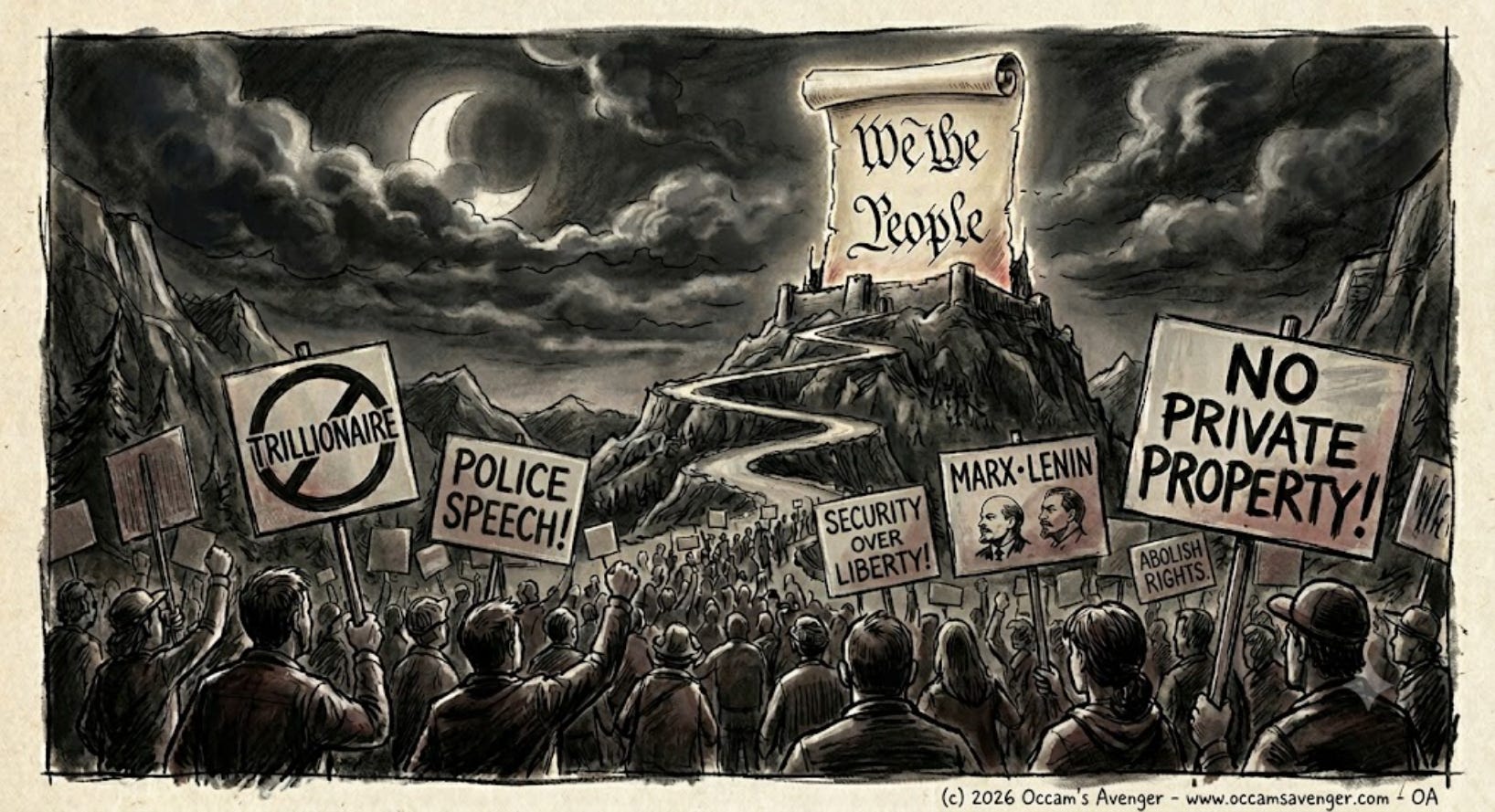
Stop looking at the corporate media’s coordinated meltdown over the “$1 Trillion” milestone as an economic debate. It has nothing to do with economics, tax policy, or paper net worth.
It is an industrial-scale conditioning experiment designed to get you comfortable with the language of a permission state.
Look closely at the precise vocabulary being synchronized across your feeds right now by political agitators and media assets:
“How did we LET this happen?”
“No one should be ALLOWED to have that much wealth.”
“Imagine the problems we could solve IF WE JUST TOOK IT.”
Let. Allowed. Just take.
Step back and look at the raw mechanics of those words. They do not belong to the vocabulary of a free Constitutional Republic. They are the vocabulary of a penal colony. They imply a baseline reality where everything you own, everything you build, and everything you achieve is merely a temporary concession granted to you by a managerial elite—a concession that can be retroactively revoked the moment you step out of ideological alignment.
The agitators are running a classic Precedent Inversion Trap. They know that if they marched out tomorrow and said, “The government should have the power to arbitrarily seize private assets and dissolve baseline property rights,” the public would resist.
So instead, they find a high-contrast cultural villain—Elon Musk—and weaponize the public’s manufactured hatred of his political views to make tyranny look like “social justice.”
They get the crowd to scream, “Yeah! Take his equity! He shouldn’t be allowed to have that!”
And just like that, the trap snaps shut. The crowd has conceded the underlying principle. They have agreed that the state has the ultimate authority to determine the upper boundaries of a citizen’s absolute rights.
The Toy-Store Economics of the Legacy Press
Look no further than a recent flagship piece in Mother Jones titled, “Why No Human Being Should Ever Be Allowed to Have a Trillion Dollars.” If you read it expecting a rigorous economic critique or a sophisticated analysis of corporate governance, you will be profoundly disappointed. The article’s entire argument against private property borders on the juvenile. It uses human counting speed, Monopoly boards, and the number of football fields you could cover in $100 bills as its baseline metric for capping human achievement.
I halfway expected the author to start measuring the wealth in Olympic-sized swimming pools, volume-units of Rhode Island, or round-trips to the moon—the usual go-to abstracts for industrial-scale journalistic size-outrage. (Though for the record, if you laid a trillion dollar bills end-to-end, they actually would reach the moon and back nearly 200 times. It’s a staggering data point, but it's a metric of systemic velocity, not a moral indictment).
It explicitly states: “Simply put, it’s way, way, way too much money for any individual to possess—not to mention that Musk didn’t earn it. We allowed him to accumulate it.”
Notice the absolute inversion of reality required to write those sentences.
First, they use the word “possess,” as if Elon Musk has a physical pyramid of cash sitting in a warehouse, hoarding it from the public. He doesn’t possess a trillion dollars. He holds equity in SpaceX—a company that just went public because it successfully built the infrastructure to take humanity to the stars.
Second, they claim “he didn’t earn it.” They are half-right, but not for the reason they think. He didn’t just earn it—he and his engineers created it from nothing. Before SpaceX, the concept of landing an orbital-class booster rocket on a robotic droneship in the middle of the Atlantic Ocean was science fiction. By turning science fiction into a repeatable commercial service, they generated entirely new wealth that did not exist in the global economy twenty years ago.
Third, they use that chilling word again: “Allowed.” “We allowed him to accumulate it.” How exactly did the American public “allow” Elon Musk to build SpaceX? By voluntarily purchasing satellite internet from Starlink? By private investors choosing to buy shares in an IPO because they believe in the future of space exploration?
In a free society, a builder “accumulates” wealth by offering goods, services, and disruptive technologies that other free citizens choose to value. Shifting the baseline to say the public “allowed” this to happen implies that your right to build a business or own an asset is entirely subject to a public opinion poll managed by media elites.
The article stumbles into its only live metric when it complains that Musk spent $292 million to support a political campaign, claiming this level of spending makes him an “untouchable oligarch.”
Let’s skip past the blatant hypocrisy that these same outlets were entirely silent when left-aligned tech titans spent $400 million injecting private capital into local election offices in 2020. Focus instead on the terrifying precedent they are trying to establish: They are suggesting that no citizen should be “allowed” to own assets greater than the amount it would take to dissent from the preferred political narrative.
If your wealth makes you powerful enough to successfully oppose the ruling establishment, their solution isn’t to out-vote you or out-argue you. Their solution is to convince the masses that your property rights should be dissolved because the number on your brokerage account is “too big” for their counting speed.
It Was Never About the Trillionaire
Once you agree to that principle for one man, you have agreed to it for everyone. You have handed the state a loaded weapon and simply prayed that the people holding the trigger will always hate the same people you hate.
History proves they won’t.
Tyranny never arrives in this country with a dramatic march and a trumpet blast; the people would fight that. It arrives through the death of a thousand cuts. It arrives by slowly cooking the frog. It relies on making the population believe that each microscopic surrender of an essential liberty is completely justified by the crisis of the week.
Mass shooting? Why do we “let” people own those? Just take them.
Pandemic? We can’t “allow” people to communicate un-vetted ideas. Shut them down.
Disfavored Public Figure? The assassination attempt, the doxxing, the economic ruin—it’s justified, because they are “bad” by our definition.
They have no consistent legal ideology, no economic framework, and no structural solutions. They have only a relentless desire for absolute institutional control, permanently managed by their preferred class from the top down. They are simply hunting for the next tragic vehicle or massive milestone to convince a temporary majority to hand over another inch of ground.
One day, the people who didn’t end up in the preferred elite class will look around at the surveillance, the asset controls, and the restricted speech, and ask themselves how we got here.
The answer will be simple: One inch at a time. And you cheered for the tape measure.